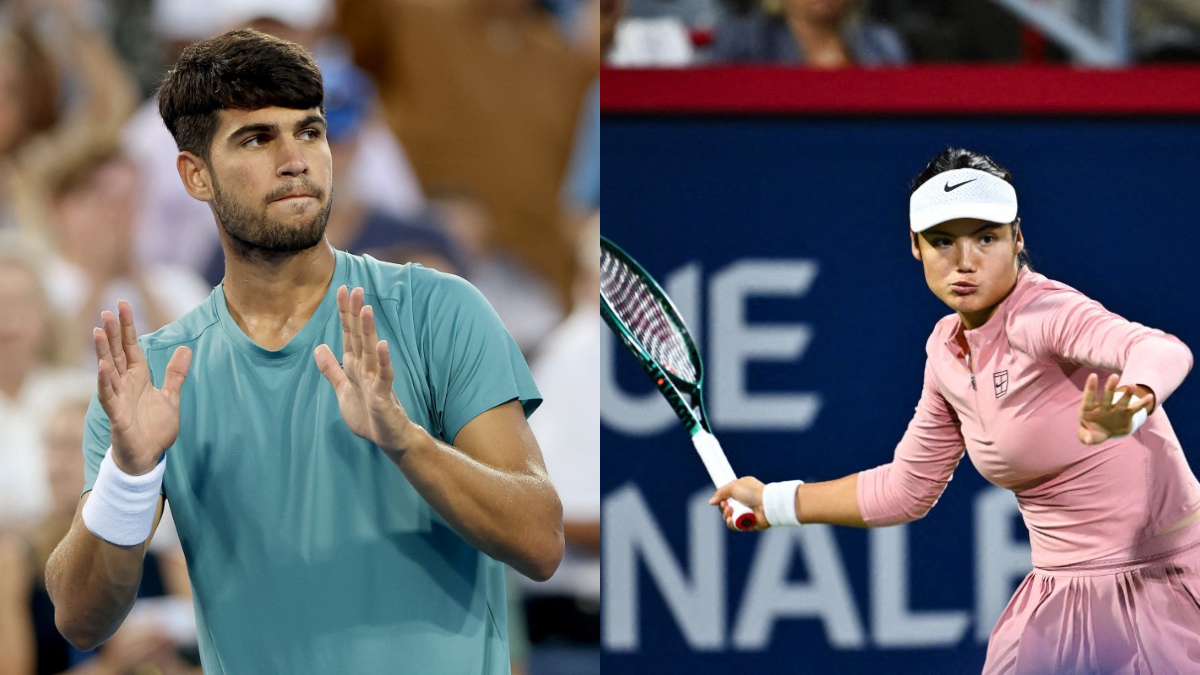
Nonconformity is a quintessential US Open trait. From being the first to introduce a final-set tiebreak way back in 1970 to allowing in-game coaching in 2022, the season’s last tennis Major has defied tradition multiple times.
Tuesday, however, will see arguably the most radical and controversial of transformations, with a new mixed doubles format ready to be showcased. It will feature only 16 teams – eight direct acceptances and eight wild cards – down from 32, and players have been allowed to enter only with their singles ranking.
The two-day affair is being played in the week preceding the Slam and will witness reduced sets (to four games, except in the final). The who’s who of singles tennis, from Carlos Alcaraz to Jannik Sinner to Iga Swiatek to Naomi Osaka, will compete without having to worry about doubles burning their singles ambitions.
ALSO READ: US Open mixed doubles tournament draw: Alcaraz-Raducanu pair to face No. 1 seeds Pegula and Draper
For the United States Tennis Association (USTA), it is about creating a buzz around a format that doesn’t exist outside the Slams and quadrennial extravaganzas like the Olympics. It can help schedule matches on the biggest show-courts such as the Arthur Ashe Stadium, sell tickets, beam the action on primetime television, and collect more in sponsorships.
But the change has left the doubles stars disappointed. “As a doubles athlete, my heart is bleeding,” said Wimbledon champion Sam Verbeek, and one can see why.
Already competing for a fraction of the prize money, doubles specialists have had the door shut on their faces. None among the ATP doubles top-10 is in the draw. Nine of them had taken part in the 2025 Wimbledon mixed doubles competition.
The women fare better, with three of the WTA doubles top-10 set to compete. But the current World No. 1 is United States’ Taylor Townsend, and not having her would have been a public relations disaster.
The Match-Ups
Top-half
Jessica Pegula & Jack Draper vs. Emma Raducanu & Carlos Alcaraz
Olga Danilovic & Novak Djokovic vs. Mirra Andreeva & Daniil Medvedev
Iga Swiatek & Casper Ruud vs. Madison Keys & Frances Tiafoe
Naomi Osaka & Gael Monfils vs. Caty McNally & Lorenzo Musetti
Bottom-half
Katerina Siniakova & Jannik Sinner vs. Belinda Bencic & Alexander Zverev
Taylor Townsend & Ben Shelton vs. Amanda Anisimova & Holger Rune
Venus Williams & Reilly Opelka vs. Karolina Muchova & Andrey Rublev
Sara Errani & Andrea Vavassori vs. Elena Rybakina & Taylor Fritz
Quick facts
1) First and second rounds will be played on Tuesday, August 19, and the semifinals and finals on Wednesday.
2) Matches until the semis will be best of three sets but with each set to four games instead of the traditional six.
3) They will feature no-ad scoring, tiebreakers at four-all and a 10-point match tiebreaker in place of a full third set.
4) Final will be a best-of-three set affair but to six games, with tiebreakers at six-all and a 10-point match tiebreaker in place of a full third set.
5) Winning team will get $1 million, a five-fold increase from $200,000 in 2024.
Thus, the nearly three-fold increase in purse from $802,000 in 2024 to $2,360,000 will mostly be pocketed by the already highly paid singles stars.
“Doubles already plays second fiddle to singles in terms of visibility, scheduling, and prize money. This move just reinforces that hierarchy,” former World No. 1 Rohan Bopanna told Sportstar.
“A Grand Slam isn’t just about singles. It’s about the entire ecosystem. When you start trimming one part, especially something that’s been a tradition, it chips away at the completeness of the event.”
What has also rankled the players is the USTA’s seemingly unilateral decision-making. “I’m honoured that they asked me to play, but how they went about it wasn’t really great,” quipped Jessica Pegula, World No. 4 in singles and a WTA Player Council member, in Cincinnati recently.
“We were like, ‘you guys (US Open) just went rogue and changed the format and didn’t tell anybody’,” the American added.
The competition is also running concurrently with an ATP 250 in Winston-Salem (USA), and it is a no-brainer as to who will enjoy the most coverage.
At a time when seven of nine ATP Masters 1000s – except Monte Carlo and Paris – have ballooned into 12-day snooze-fests, elbowing out smaller tournaments, the US Open’s move doesn’t inspire confidence. Can a global sport further allow the shrinking of its footprint?