New Delhi
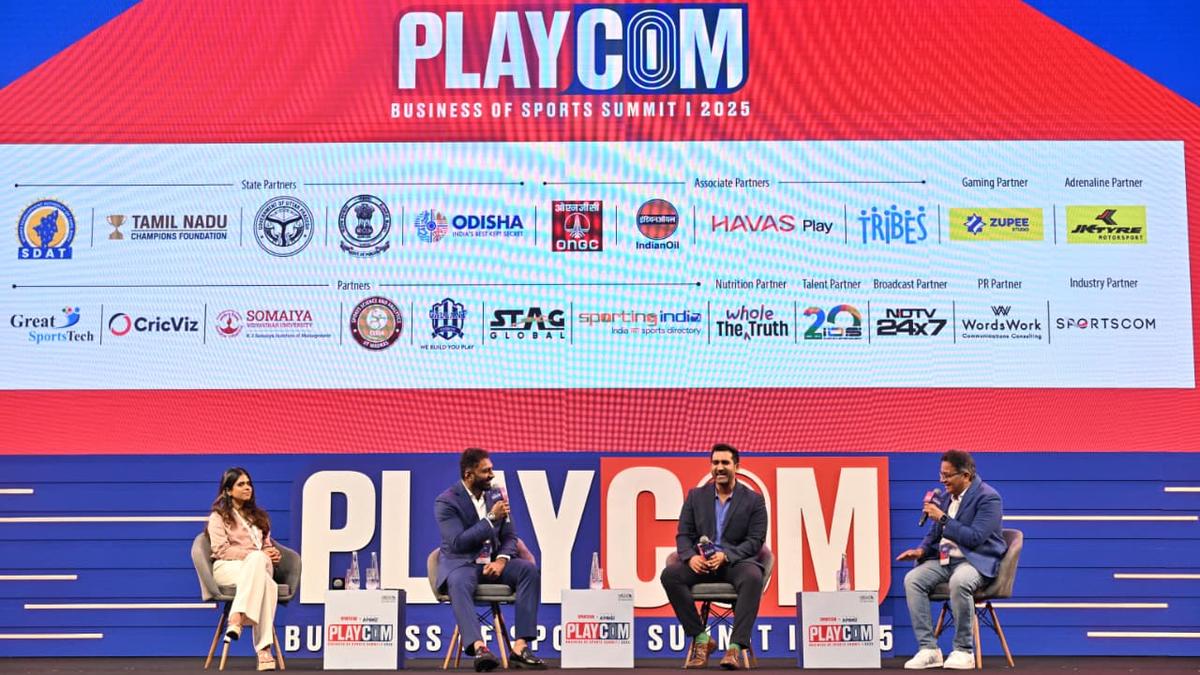
The second day of PlayCom 2025 opened with a lively discussion on integrating youngsters into India’s sporting landscape. In the panel Young Turks – A New Sporting Vision for New India, Hannah Muthoot (Director, Muthoot Sport, Muthoot Pappachan Group), Akhilesh Reddy (Chairman & Managing Director, Racing Promotions Pvt. Ltd.), Suhail Chandhok (CEO, U Mumba & Co-Founder, Elev8 India Sportz), and Suresh Balakrishna (Chief Revenue Officer, The Hindu Group) explored the need to push boundaries while reimagining what it takes to build a sporting ecosystem.
From volleyball in Kerala and motorsport nationwide to kabaddi on the national stage, Hannah, Akhilesh, and Suhail reflected on the challenges and opportunities of turning vision into impact.
For Hannah, sport was a natural extension of her family’s legacy. “My journey has been driven by a deep passion for social entrepreneurship,” she explained. “When I came back into the family business, I dabbled in CSR work, but not from the traditional lens of charity. For me, it was about empowerment and development. We began translating CSR into CSV, and sport became the perfect ingredient to achieve that.”
Her focus on volleyball through the Prime Volleyball League reflects a deliberate attempt to build more than just a tournament. “I entered sport after much of the initial groundwork was done by my father. Since then, we have evolved volleyball through PVL, which is now in Season 4. I don’t see it as a closed ecosystem. People have genuinely wanted to guide and support me in developing it. We’ve had the strongest backing from football federations in Kerala, particularly in grassroots and education initiatives.”
Yet, sustainability remains a challenge. “Can we truly build a brand? Our academies in Kerala are recognised, but to strengthen the ecosystem we need younger players to come in through colleges and our academies. Combining all three — grassroots, colleges, and academies — is a challenge,” she said, adding that their aim is to create synergy across the system.
Akhilesh entered motorsport equally driven by passion, while acknowledging its expense. “Motorsport is costly, but not the costliest. I believe every sport has value because each brings something back to the country’s economy.”
For him, motorsport is not only about racing but also about building an industrial ecosystem. “Motorsport has the power to create industrial establishments, generate jobs, and become a platform for R&D and technology. It can push engineers and mechanics into innovation. There are already kids passionate about working on car engines. Motorsport gives them a pathway to turn that into careers, therefore boosting employment, and contributing to the GDP.”
Suhail sees sport as community-building rather than just competition. “Being part of sport myself, both as a player and later as a broadcaster, gave me a unique lens to see its different aspects,” he recalled. “In 2014, when the kabaddi revolution began, I saw an opportunity. The requirements were clear: stakeholders, quality of sport, and emotion.”
Pointing out that kabaddi is short, pacy, and audience-friendly, Suhail added that the Pro Kabaddi League appeals across generations. “When you turn up at a kabaddi stadium, there’s the grandparents who played the game, there’s the kids today that find it cool again and then there’s the kabab mein haddi (middle) generation,” he quipped.
For Suhail, success must also be measured by social impact. He cited one striking story: “So we had a team from Uttarakhand that didn’t do very well (in Yuva Kabaddi series), but we spotted one really bright young talent there. His team got knocked out early, so we moved him to the Pondicherry team. That team made the finals, and the boy did really well. The year before he played Yuva, he was maybe earning 20-50,000 rupees a year from kabaddi. Then he came through our series, made the final, got spotted by scouts in Pro Kabaddi, and earned himself a 78-lakh-rupee contract in the auction. When he went back to his village, they held a two-and-a-half kilometre-long procession to welcome him. Now in that village, there are fewer drugs, less alcoholism, and more people playing kabaddi!”
Still, Hannah emphasised that deeper community engagement is critical. “Unless there is year-long activation (of community building), Indian youth won’t feel connected to what they see on screen. We can’t keep everything online — it has to be a hybrid activation model.”
Suhail agreed: “When the community is engaged, more people start believing in what you are building. If we work with stakeholders, there is enough strength to grow something which everyone can benefit from. It should be about the appreciation of sport, not just individual heroes.”
Akhilesh, too, stressed nurturing the next generation, especially in racing. “Since day one, I had a simple target: I want to see another Narain (Karthikeyan) or Karun (Chandhok) in Formula 1. We’ve already been working on that for the last three years. We are identifying Indian kids who are really good and giving them free seats in Formula 4. If possible, we then push them into the Formula Regional Middle East Championship and eventually Formula 3. At the same time, we’ve been offering free internships to engineering students for the last three years. This year I’m going to employ at least five or six engineers within RPPL itself, where they can regularly work on the cars. I personally want to see at least one Indian kid in Formula 1 and one female driver in Formula 2.”
He outlined his larger ambition: “Alongside that, in the next two to three years, I want a complete Indian team. By team, I mean engineers, data analysts and mechanics. As of now, if you want to run a motorsport championship anywhere in the world, you need Europeans to come and do it. But my goal is that within the next two to three years, we will have our own team ready to travel across the globe and deliver the job.”
Hannah summed up the panel’s spirit when she said: “At Hannah, we intend to bring as many kids as possible into the pyramid, create enough opportunities, and ultimately unlock podium finishes. Not just for medals, but to ensure that everyone has a chance to be part of the journey.”
PlayCom sponsors
State Partners: Sports Development Authority of Tamil Nadu (SDAT) | Tamil Nadu Champions Foundation | Government of Uttar Pradesh | Government of Punjab | Government of Odisha
Associate Partners: ONGC | IndianOil | Havas Play | Tribes
Gaming Partner: Zupee Studio
Adrenaline Partner: JK Tyre Motorsport
Partners: Great SportsTech | CricViz | Somaiya Vidyavihar University (K J Somaiya Institute of Management) | Centre for Sports Science and Analytics (CESSA), IIT Madras | Gallant Sports & Infra Ltd | STAG Global | Sporting India – India’s Sports Directory
Nutrition Partner: The Whole Truth
Talent Partner: IOS Sports & Entertainment
Broadcast Partner: NDTV 24×7
PR Partner: WordsWork Communications Consulting
Industry Partner: SportsCom
Published on Sep 13, 2025