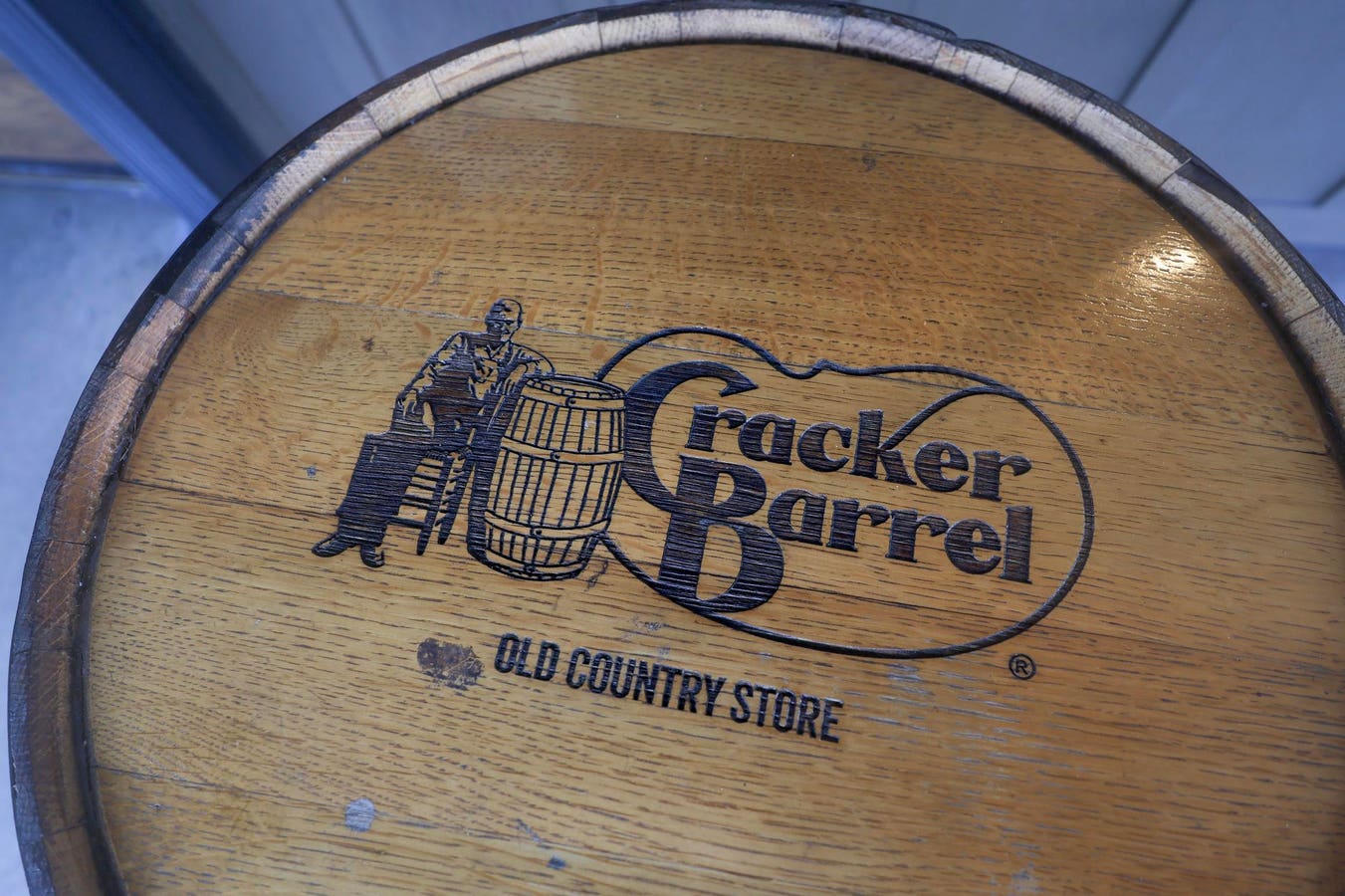
HOMESTEAD, FLORIDA – AUGUST 21: A Cracker Barrel sign featuring the old logo is seen outside of a restaurant on August 21, 2025 in Homestead, Florida. The restaurant unveiled a new logo earlier this week as part of a larger brand refresh. The new logo removes the image of a man sitting next to a barrel and the phrase “old country store”. Now the logo will feature the words “Cracker Barrel” against a yellow background. (Photo by Joe Raedle/Getty Images)
Getty Images
Cracker Barrel should have left well enough alone. In the first earnings call after its catastrophic rebrand, which triggered an immediate customer backlash and forced a sheepish reversal, the company reported a 5.4% increase in comparable store-restaurant sales, and a 4.4% revenue gain in Q4 2025.
In more positive news, Cracker Barrel ended the year up 2.2%, hitting the high end of guidance at $3.5 billion and it bettered its adjusted EBITDA target at $224.3 million, up 9%, adjusting for the 53rd week in 2024.
The problem is that these positive results came before Cracker Barrel’s rebrand announcement. The company’s fiscal year ended Aug. 1 and the “All the More” rebrand, new logo and plans to remodel 660 stores was announced Aug. 19. A week later, Cracker Barrel reversed course on the logo change and then, in September, it canceled plans for the remodel.
Cracker Barrel’s Self-Inflicted Damage
Now Cracker Barrel is left to pick up the pieces. Foot traffic declined 8% after the rebrand announcement and management is expecting year-end foot traffic to be off between -4% and -7%, assuming sequential quarterly improvements after investing an additional $16 million in advertising and marketing. It’s guidance on total revenue is in the $3.35 billion to $3.45 billion range, and adjusted EBITDA is estimated to drop to between $150 million and $190 million.
CEO Julie Masino delivered a few bits of good news. Cracker Barrel signed up 400,000 new loyalty members since the beginning of August, including 300,000 after the rebrand brouhaha erupted. There are now more than 9 million loyalty members who account for about 35% of sales.
Cracker Barrel restaurants will also continue with menu updates and revive old favorites, like Uncle Hershel’s breakfast and freshly-made biscuits. But a 4% to 5% price increase is baked into plans, even after raising prices 4% last year.
While Masino reassured investors when she said in a statement that, “many elements of our plan are working well and delivering results,” many investors aren’t buying it.
The day before the rebrand announcement, shares were trading at $60 per share and have fallen by nearly 18% to close at $49.55 on Wednesday, before the earnings release. After hours trading took another 9% off stock prices, according to MarketWatch.
Listening Fails
During the earnings call, Masino stressed that the rebrand changes were made after conducting “extensive research” to inform the strategic plan. Then she excused the rebranding mistake because the research couldn’t capture “how much our guests see themselves and their own story in the Cracker Barrel experience, which is what’s led to such a strong response to these changes.”
Obviously, the planning team conducted the wrong research or ignored the results delivered. And since they made such a mess of it before, it doesn’t inspire confidence in the new “listening” efforts the company is putting in place.
Cracker Barrel is launching a “Front Porch Feedback” program, where loyalty reward members can provide comments about their most recent visit.
“We will be listening to and actioning initiatives based on their valuable input,” Masino said, as she emphasized the company will be “leaning into Cracker Barrel’s heritage, listening to, and deepening the connection with our guests.”
“We thank our guests for sharing their voices and love for the brand and telling us when we’ve misstepped,” she added. “We’ve listened carefully.”
More Nostalgia, Please
In the rebranding debacle, the company decided that to attract new customers, a complete top-down brand overhaul was required.
“The choices people have, their expectations around food and experience, the way they travel, and their technology have all changed dramatically over the last decade, and the company had not kept pace,” Masino said at the time.
All of that is true, as the cultural strategy consultancy Collage Group’s research shows. Over 90% of consumers report they are challenged by greater complexity, fragmentation and polarization in the world today. But Cracker Barrel read the tea leaves wrong.
Because of all the changes consumers are facing, they are “actively seeking stability and trust from the brands they engage with,” Collage’s vice president Victor Paredes observed, noting that quick-service restaurant and fast-dining customers are open-minded and looking for innovation.
However, he cautioned that QSR brands must find the right balance between innovation and “safeguarding the comfort that loyal customers treasure.” And he reported that GenZ customers – ostensibly the new customers Cracker Barrel hoped to attract with the rebrand – place a higher value on comfort quotient.
“GenZ, in particular, shows us that trendy and traditional can coexist when brands strike the right balance,” he said.
Leaning into Cracker Barrel’s nostalgic comfort, rather than abandoning it, is the right recipe to bring in a whole new generation of customers. Sadly, Cracker Barrel’s leadership only discovered that after the fact.
Ask For Forgiveness
In Cracker Barrel’s rebrand misstep, it followed the popular trope, “It’s better to ask for forgiveness than permission.” While in this case it would have been better to have asked for permission first, Americans, as a general rule, are a forgiving bunch.
Stephen Hahn, chief reputation and strategy officer at RepTrak, the reputation management firm, said Cracker Barrel will recover eventually.
“Cracker Barrel will likely bounce back and fully recover its reputational equity – even enhance it with consumers,” Hahn said, referencing the audience his firm tracks in its RepTrak Compass survey. “An opportunity exists for Cracker Barrel to amplify perceptions of food quality, value for money, hospitality and comfort as a way to make the ‘old world’ seem relevant for today,” he added.
However, after getting so much wrong, does the leadership team have the insight and empathy to get the next steps right? Psychologist, executive coach and organizational consultant, Brion Carroll, Ph.D., has doubts.
“True leaders don’t just react to problems, they anticipate them. This CEO and senior team failed to analyze, failed to predict and failed to lead,” he wrote in a no-holds-barred LinkedIn article.
Asking for forgiveness is only the first step. Cracker Barrel’s leadership must earn back trust among all brand stakeholders – customers, employees and investors. Only then can they get Cracker Barrel on the road to recovery.