Topline
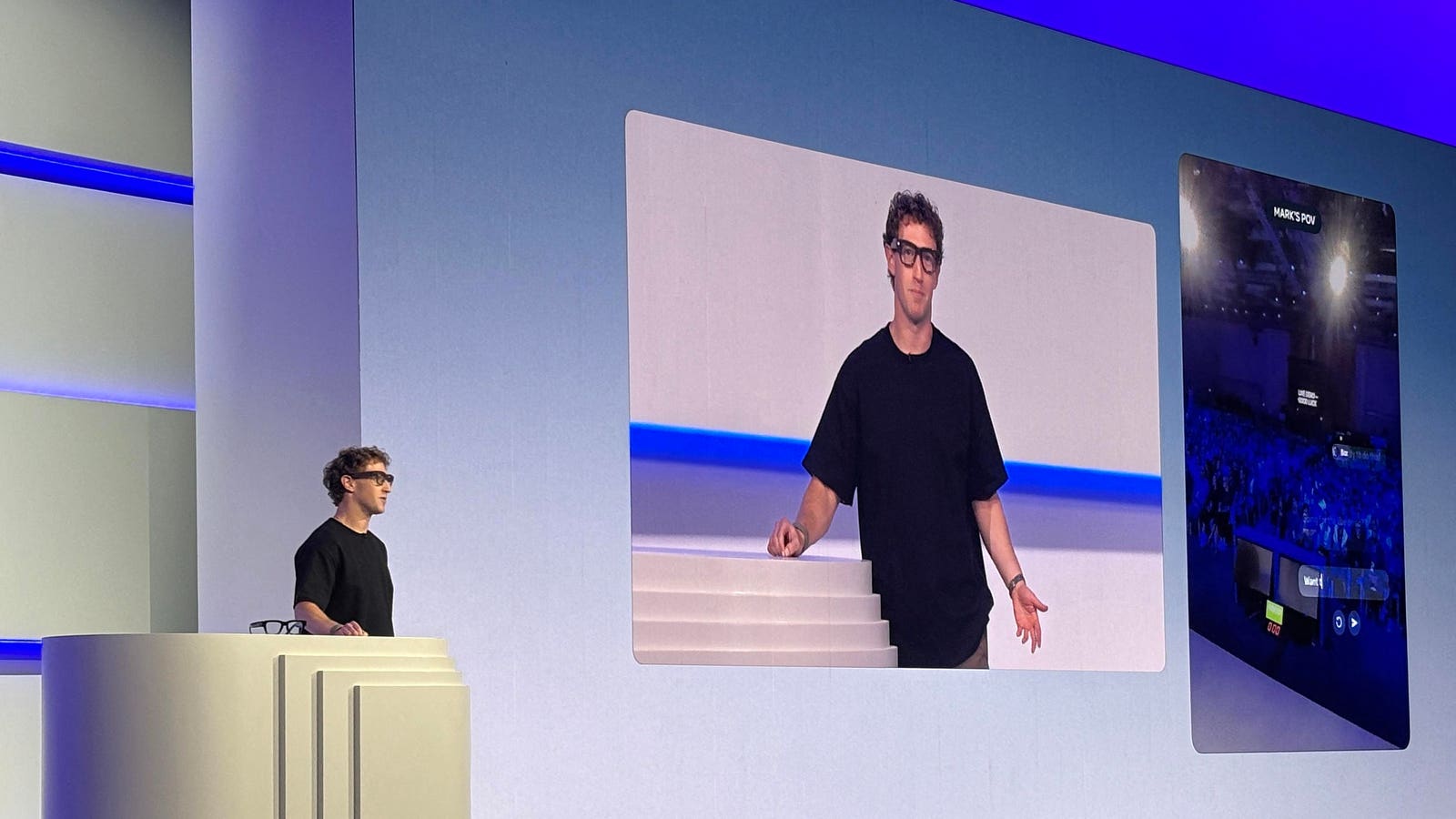
Meta showed off a new pair of AI-powered smart glasses with a built-in see-through display at the company’s Meta Connect keynote on Wednesday night, with the company’s CEO Mark Zuckerberg claiming that the device would serve as the ideal platform for “personal superintelligence.”
Meta CEO Mark Zuckerberg speaks as he presents the new Meta Ray-Ban Display at the 2025 Meta Connect conference in Menlo Park, California.
AFP via Getty Images
Key Facts
Meta’s share price rose more than 1% in premarket trading earlier on Thursday, rising to $783, just hours after the company showed off its latest wearable device.
The glasses, which are called the Meta Ray-Ban Display, will be available to purchase on September 30 and cost $799.
The glasses feature a high-resolution built-in see-through display on the right lens, which can be used to read messages, receive video calls, and follow map directions.
The glasses also feature a built-in 12-megapixel camera that will allow users to take photos and record videos.
The wearable device can be controlled using a wristband—which Zuckerberg claimed was the “world’s first mainstream neural interface” that can detect gestures and hand movements.
At launch, the Meta Ray-Ban Display will support a selection of Meta’s own apps, including WhatsApp and Facebook Messenger—along with third-party apps like the music streaming platform Spotify (there will also be an Instagram app, which will only support direct messages at launch).
Tangent
The Paris-listed shares of EssilorLuxottica—Ray-Ban’s parent company—were also up around 1.6% to $324.73 (€274.50). The smart glasses will be sold at the eyewear company’s stores along with Best Buy and specific Verizon outlets.
What Did Mark Zuckerberg Say About The Meta Ray-Ban Display?
Zuckerberg has argued that smart glasses like the Meta Ray-Ban Display will one day surpass smartphones as the primary personal computing device for most people. During the keynote he appeared to reiterate this stance, saying: “Glasses are the ideal form factor for personal superintelligence, because they let you stay present in the moment while getting access to all of these AI capabilities that make you smarter, help you communicate better, improve your memory, improve your senses, and more.” He added that this was the only type of device “where you can let it see what you see, hear what you hear, talk to you throughout the day and very soon, generate whatever [user interface] you need right in your vision, in real time.”
How Does The Meta Ray-Ban Display Compare With Meta’s Other Wearables?
The new smart glasses is the second major wearable product released as part of the collaboration between the luxury eyewear brand and the tech giant. The Ray-Ban Meta, which launched in 2023, does not feature a display, but instead comes with two cameras, built-in speakers, a microphone and a touchpad on the frame. On Wednesday night, Meta announced an updated version of these glasses with larger battery, with prices starting at $379. The company also sells the Meta Quest line of virtual reality headsets, previously known as the Oculus Quest. The Quest headsets have significantly higher resolution displays at 2064 × 2208 pixels per eye compared to the 600 x 600 pixels on the right lens for the Meta Ray-Ban Display. However, they are significantly bulkier and users have to rely on its cameras to see outside the headset—unlike the new glasses which are see-through.
How Do The Smart Glasses Compare To Wearables Made By Rivals?
Google announced the now discontinued Google Glass back in 2012, but they were experimental devices primarily targeted at developers and companies instead of consumers. The glasses sold for $1,500, and featured a small heads up display in front of the lenses. The company stopped selling the original prototypes in 2015, but a enterprise edition was sold to manufacturing companies for for the next few years, but the search giant discontinued them in 2023. Microsoft, launched its own augmented reality glasses in 2016, called the HoloLens. The device, priced at $3000, was only sold to developers and never received a consumer version. In 2018, the company announced it had secured a $480 million contract to sell HoloLens to the U.S. military. Apple launched the Vision Pro, its first wearable display in February last year, priced at $3,499. However, the product hasn’t been able to match the commercial success of other devices in Apple’s portfolio, an is estimated to have sold less than 500,000 units in 2024.
Further Reading
Meta Launches $799 Glasses With Screen and AI Integration (Bloomberg)
Meta unveils new smart glasses with a display and wristband controller (Techcrunch)