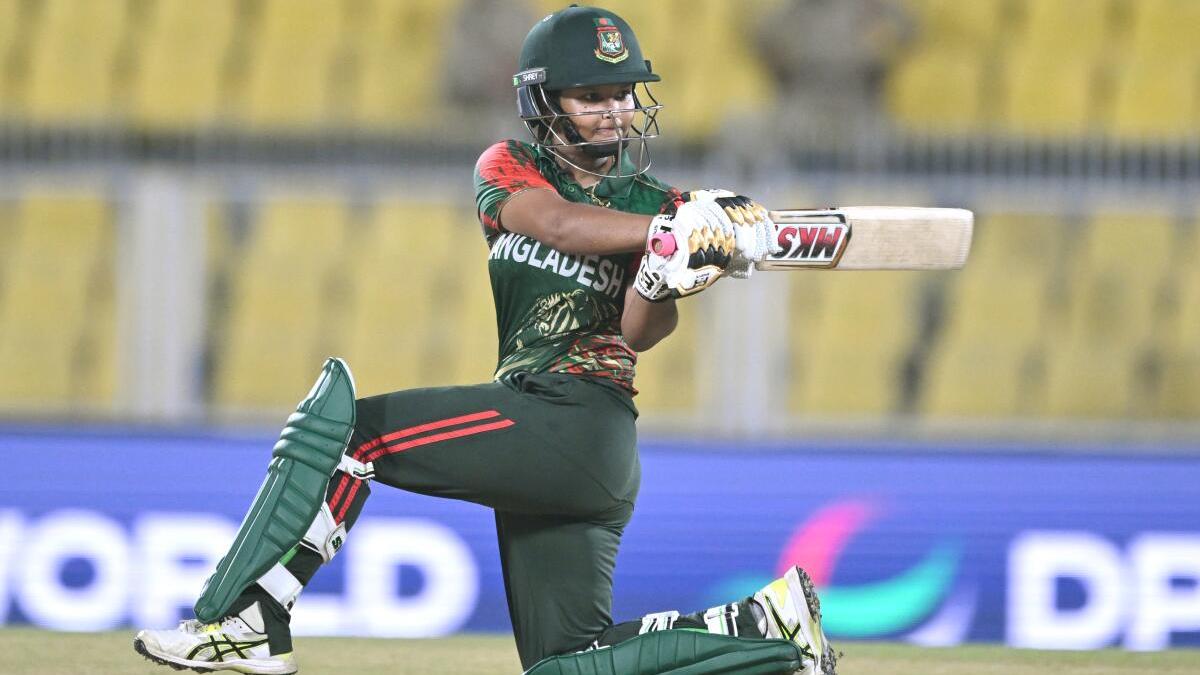
On May 14, 2018, a 16-year-old Sobhana Mostary became Bangladesh’s fourth-youngest debutant in women’s ODIs. It was a trial by pace as she faced South Africa’s Marizanne Kapp and Shabnim Ismail. The raw pace of the latter is still fresh in the batter’s mind.
“I remember facing Shabnim Ismail in my first few deliveries on debut. Back then, she was one of the fiercest bowlers. I was wearing an ordinary pad, and one of her deliveries hit me on the leg. I told myself, ‘If I have to play at this level, I need to be brave.’ I made five runs and remained not out,” the now 23-year-old tells Sportstar on the sidelines of the ongoing ICC Women’s World Cup 2025.
ALSO READ | Calm and understated Brooke Halliday a vital cog in New Zealand’s impending transition
A few days ago, Mostary faced the Proteas again—her second outing against them in the 50-over format. While her returns were modest, this tournament has been rewarding overall. Against four-time champion England, in a match where Bangladesh ran the English close, Mostary compiled a steady 60 off 108 balls—her first international half-century in a seven-year career.
“In T20Is, I’ve got out in the forties a few times. I feel I’ve broken that barrier against England, and now I hope to cross this mark and inch closer to a hundred,” she says. Still, she admits she’s been wasteful with her opportunities.
Getting the confidence back
“I don’t think I’m a successful batter. I’ve spent more than six years with the team and had plenty of chances. Maybe, someone else in my place would’ve used them better,” Mostary says.
This is her fifth World Cup—three T20 and two ODI—and her first real taste of the showpiece came at the 2020 T20 World Cup in Australia, where she played just one game. The last ODI World Cup in New Zealand was similar.
ALSO READ | Marufa Akter: ‘It’s me vs me, not me vs others’
“When I went to Australia in 2020, I was a junior. For almost three years, I just travelled with the squad. Watching the seniors, I learnt a lot. In the last ODI World Cup, I got the chance to closely look at all the big teams and how they operate,” she recalls.
Fatema Tuz Jahara, who coached Mostary in her formative years, believes her inconsistency stems from a lack of regular game time.
“The international level is very different. You need fitness and experience. Maybe Sobhana camped with the team for years and overtrained, which made things harder,” Jahara explains.
“A player who’s travelling but not getting matches isn’t gaining real experience. Her batting positions—from No. 3 to No. 7—also mean she rarely bats in relaxed situations. Constant failures in those moments can take a mental toll.”
An unusual talent
Jahara remembers a 10-year-old Mostary walking into BKSP (Bangladesh Krira Shikkha Protishtan)—the country’s only government-run sports institute—seeking admission.
“We used to have annual admission tests. Sobhana came very young; it was unusual because our system accepted students from seventh standard onwards. But she was so gifted—her shots were unbelievable—that we made an exception. She was given temporary training for a year and then formally joined in sixth standard,” the coach says.
Hailing from Rangpur, and the only child of a police inspector father (who is retiring this month) and a senior nurse mother, Mostary began playing with boys in her neighbourhood. With support from her family—especially her cousin Aleef and two uncles—her cricket ambitions gained early momentum.
“At BKSP, I studied and trained simultaneously. Slowly, while playing in the Dhaka Premier League (DPL), I was called up for the senior team,” she says.
Mostary continues to play in the Dhaka Women’s Premier League, and scored 183 runs in six innings for Mohammedan Sporting Club last season.
“I remember Pinki di (Fargana Hoque) giving me 500 taka after a good knock, saying I’d go far. Those DPL performances earned me my senior team call-up. In the domestic circuit, I would normally bat in the top order, but in the national team, our selector told me that if I went out to open, I wouldn’t be able to bat. I was happy to bat lower in the order,” she says.
Since her DPL days, Jahara says, Mostary has expanded her range of strokes. Her power hitting was always an asset, and it continues to help her clear the ropes.
With the formidable Australians up next, Mostary remains optimistic about Bangladesh’s prospects.
“There’s the excitement from the youngsters and the understanding of the seniors, which has resulted in unity that can be seen on the field,” she says.
Published on Oct 16, 2025