Two head coaches, a national league in limbo, players skipping national camps, and a federation seemingly adrift — the last eight months in Indian football have culminated in failure to qualify for the AFC Asian Cup for the first time since 2019.
On paper, India was expected to top Group C of the qualifiers, which included lower-ranked sides Hong Kong, Singapore, and Bangladesh. Yet, after four rounds, the Blue Tigers sit bottom of the table, winless, with just two goals to show.
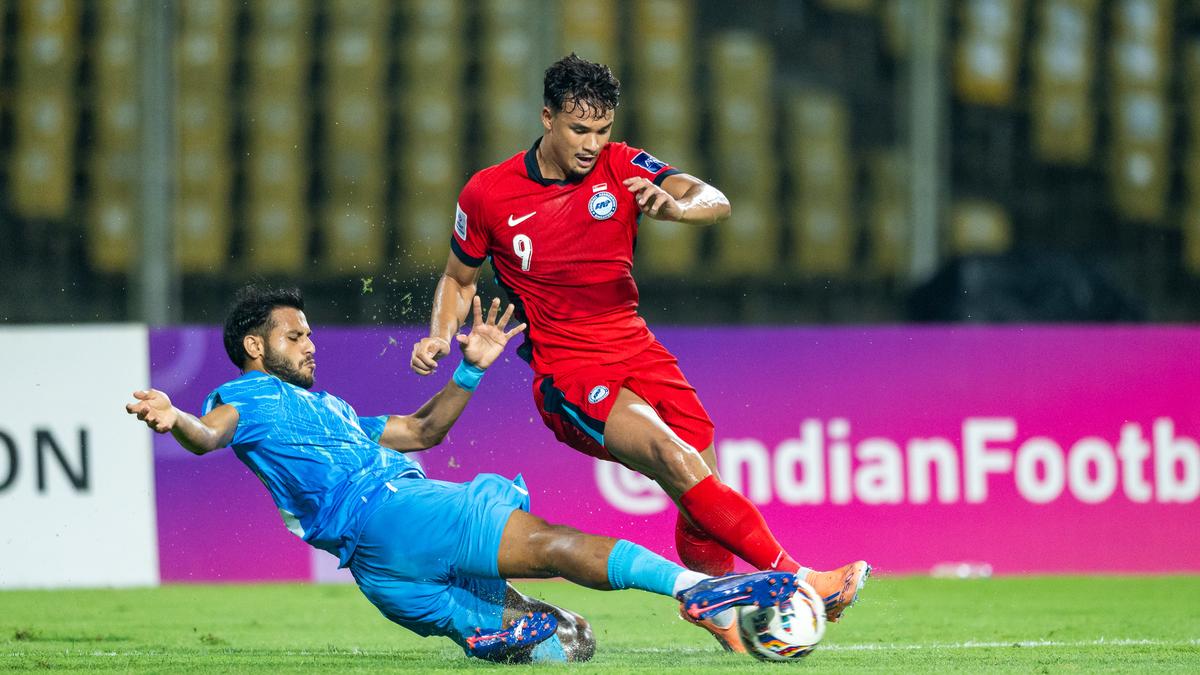
If last year’s results were bad, this year’s have been worse when it mattered most. The defeat to Singapore in Goa was another dismal night — only 10% of the 19,000-seater stadium was occupied. Unless the people in charge act decisively, Indian football will continue its quiet fade into irrelevance.
Somewhere in the same State, former head coach Manolo Marquez might have watched with a sense of relief that he was no longer the face of this failure.
Managing the national team was once a dream for Marquez, but the job quickly soured. “When you see that all the teams don’t play by the same rules [naturalisation process], you feel like this isn’t the place for you,” he conceded in an interview with Marca.
Three days before the away game in Hong Kong in June, the players already knew it would be the Spaniard’s last match. India went on to lose to Hong Kong for the first time in 15 years. Marquez pointed fingers, including at himself, before resigning in July, less than a year into the role.
The Federation’s next move felt like a last-ditch appointment. Khalid Jamil ticked many boxes: he communicates well with players, has turned underdogs into contenders, and, crucially, tends to make the most of limited resources without complaint. Even after the loss to Singapore, Jamil refused to single out individuals.
Unlike his predecessors — Igor Stimac and Marquez — Jamil is unlikely to generate headlines about how the sport is run in India.
On the field, however, his appointment meant an abrupt shift in philosophy midway through the qualifiers: from Marquez’s possession-based style to Jamil’s defensive structure.
The transition between two vastly different systems disrupted continuity. Across four matches, 38 players were called up and 18 changes were made to the starting elevens since the Bangladesh fixture in March.
What should have been the pinnacle of Jamil’s coaching career instead became a trial by fire — a faltering qualifying campaign riddled with obstacles.
His job was made harder by the ISL’s uncertain future, players arriving at his first camp in August without proper pre-season training, and with Mohun Bagan refusing to release its players despite the FIFA window. “We will adjust with the players we have,” Jamil said at the time.
To his credit, India finished third in the eight-team CAFA Nations Cup, recording positive results against Tajikistan and Oman and pushing Iran close. Those outcomes briefly restored optimism ahead of the double-header against Singapore.
But the problems persisted. Before the Singapore games, 14 of the 23 players in the travelling squad failed to report on the first day. Rahim Ali, Subhasish Bose, and Lalengmawia Ralte, who would later impress against Singapore, were not even part of his original probables.
Lalengmawia is easily India’s best all-round midfielder — a player the team can be built around for the next few years. But why did the coach decide his experience and quality were vital only three days before the Singapore home tie?
Despite his reservations, Jamil delivered on the promise of attacking football for his first home match in charge. His team played with intent and energy, qualities that had been missing from the national side in recent years, but fatigue soon eroded that intensity.
Jamil attributed the errors to the lack of top-tier match practice. “Yes, before this preparation also, we tried to call players early, but we didn’t get them since there were many problems. We had to solve it,” he said.
It’s worth asking whether the result, despite India’s attacking effort, will only harden Jamil’s belief that defence-first football is the way forward.
“At home, we have to attack,” he said when asked if India would persist with that approach, before adding, “I like defending more. You can say, today, we attacked and lost. For me, the result matters.”
Still, Jamil should not be made a scapegoat for the malaise surrounding the team. Everyone knew what they were getting with him, yet somehow expected something different. In 15 matches before his appointment, India had scored more than one goal only once — a 3-0 win over the Maldives — and failed to score in 10.
The CAFA Nations Cup and the home fixture against Singapore suggested Jamil deserves time and space to rebuild. If India is to become a disciplined, low-block side capable of grinding out results, he needs institutional backing.
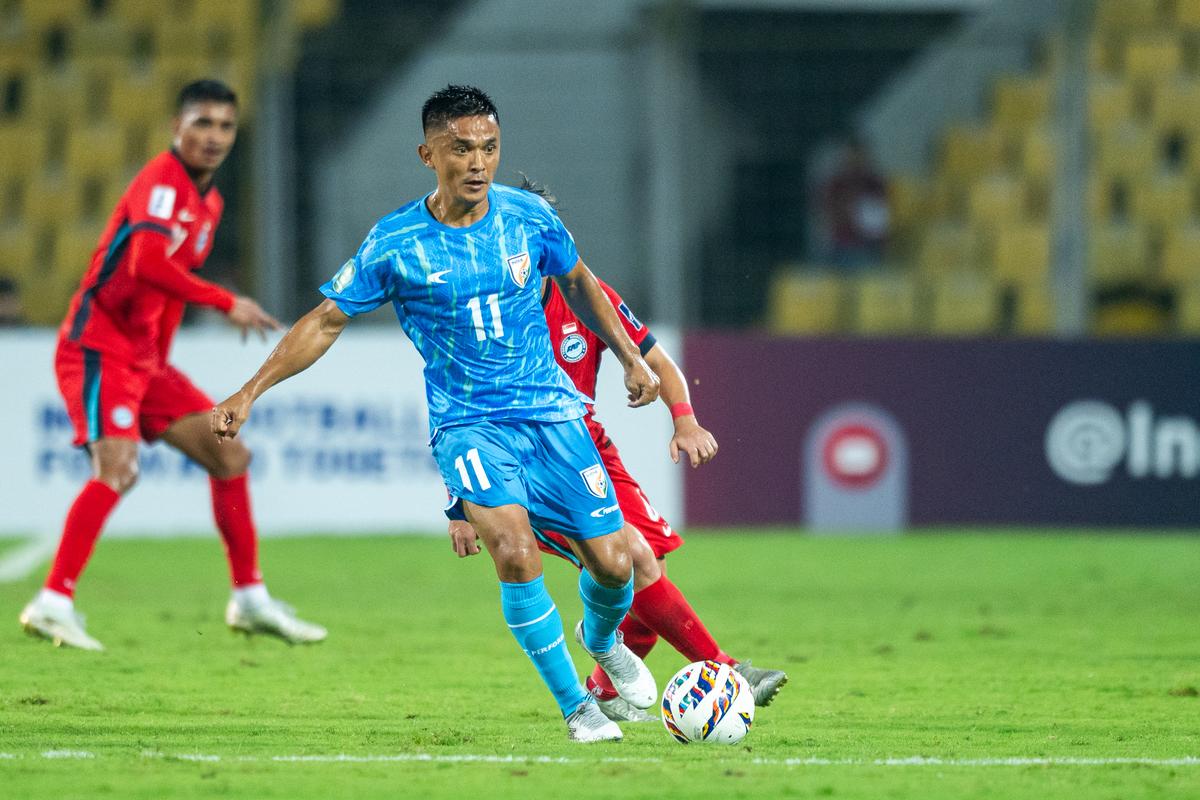
Last sentinel: Sunil Chhetri’s presence still commands respect, even as India grapples with life after him.
| Photo Credit:
AIFF

Last sentinel: Sunil Chhetri’s presence still commands respect, even as India grapples with life after him.
| Photo Credit:
AIFF
Jamil’s defensive philosophy may not please the purists, but results are now a necessity. His club-level success often relied on foreign strikers who could spearhead his counter-attacks. With the national team, even Sunil Chhetri can’t answer the lingering question: who after Chhetri? Jamil defended his inclusion, saying, “He is one of the best strikers we have.”
Yet with two dead rubbers left in the campaign, Jamil was non-committal about the veteran’s future. “We will think about it later. This is not the right time to speak on Chhetri,” he said.
With the next World Cup and Asian Cup qualifiers likely two years away, a decision on the 40-year-old’s international future should be among Jamil’s easiest calls.
But for Jamil to put the pieces together, he needs help from those above him. There is still no clarity on the ISL and I-League’s status, and three international windows could pass before the domestic structure resumes.
If decisive action doesn’t follow soon, this failed qualification campaign will no longer be an exception — it will become the norm.
Published on Oct 16, 2025