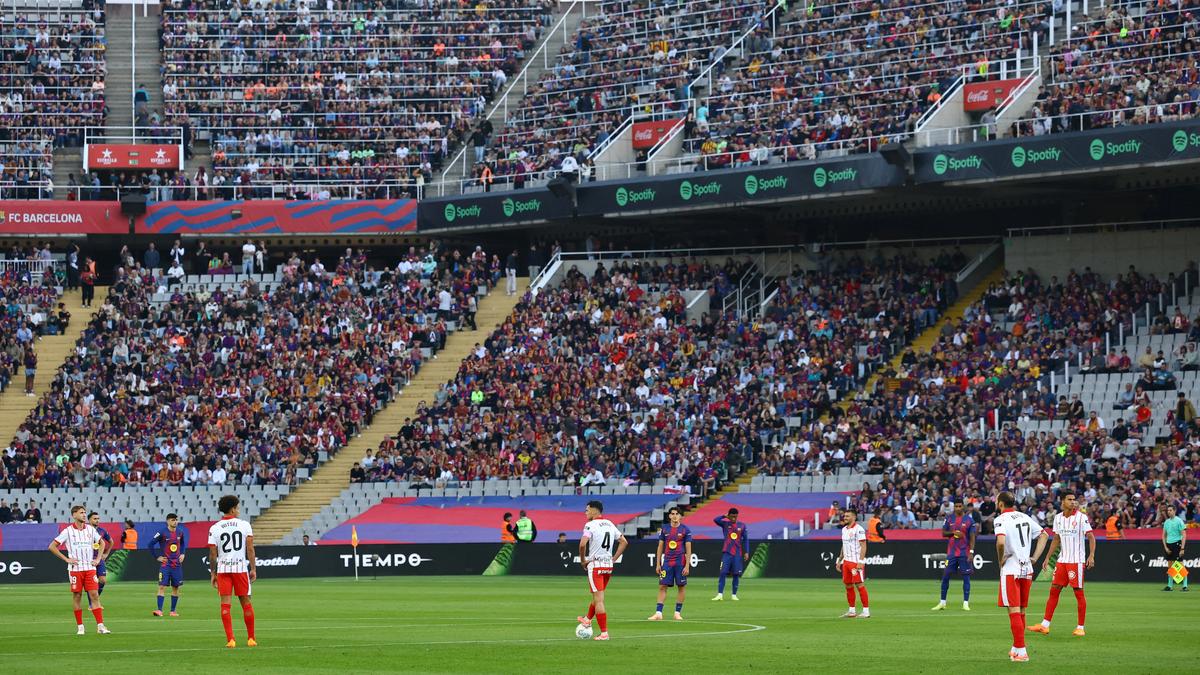
Barcelona and Girona players stood still for 15 seconds after kickoff in their La Liga clash on Saturday — a coordinated protest against the league’s decision to stage a regular-season game in the United States. Here’s what you need to know about the controversy.
Q: What exactly happened at the Olympic Stadium?
A: After Girona kicked off, both teams remained motionless for the first 15 seconds. The gesture mirrored similar pauses in earlier La Liga matches that weekend, beginning with Real Oviedo vs Espanyol on Friday.
Q: What were the players protesting?
A: The protest, organised by the Spanish Footballers’ Association (AFE), targeted La Liga and the Spanish Football Federation’s decision to move Barcelona’s December 20 away fixture against Villarreal to Miami’s Hard Rock Stadium. The AFE accused the league of showing a “lack of transparency, dialogue and coherence” in making the move.
Q: Were Barcelona and Villarreal forced to join the protest?
A: No. The AFE said both clubs’ players were not obligated to participate since it could put them in a difficult position with their employers. However, Barcelona’s players joined voluntarily “out of respect” for their peers. “We were not part of the [protest] but we felt we needed to follow along,” said midfielder Pedri.
Q: Why is the match being played in Miami?
A: La Liga has long sought to take a regular-season game to the U.S. to boost its global reach. After several failed attempts since 2017, the league finally secured approval from the Spanish Football Federation (RFEF) and UEFA.
Q: How have clubs and players reacted?
A: Opinions are split. While Barcelona and Villarreal agreed to the plan, Real Madrid has strongly opposed it, calling it “an unacceptable precedent” that offers “an undue sporting advantage” to the teams involved. Even Barca’s Frenkie de Jong said he doesn’t support the idea, echoing Madrid’s concerns. “I can understand the clubs; they’ll profit from it. But I wouldn’t have decided it myself. I don’t agree with it either. It’s also unfair, competitively speaking. We will now be playing an away match at a neutral venue. But I don’t feel like anyone is listening to us,” De Jong said.
Q: What is La Liga’s stance?
A: The league maintains that the Miami fixture represents progress in expanding Spanish football’s global footprint. It insists that necessary regulatory and logistical clearances have been secured.
Q: Could the AFE block the match?
A: Not directly. The union’s approval isn’t required for the game to proceed. Still, AFE president David Aganzo said he has reached out to political parties and may consider further action after the weekend’s symbolic protests.
Q: What’s next?
A: La Liga plans to go ahead with ticket sales next week. Meanwhile, the players’ union may step up pressure, setting up a fresh confrontation between the league’s commercial ambitions and the players’ collective voice.
Q: Has this happened before in other leagues?
This is not the first time a major football league has flirted with the idea of taking competitive fixtures abroad. In 2008, the English Premier League proposed the “39th game,” an additional overseas round that would have seen clubs play in cities such as New York, Sydney, or Dubai. The backlash from fans, clubs, and FIFA was immediate and fierce — the plan was scrapped within weeks. Since then, the Premier League has limited itself to pre-season events such as the Summer Series in the U.S. and the Asia Trophy.
Serie A is attempting something similar. Como and AC Milan are scheduled to play a league match in Perth, Australia in February 2026. Como said the move is motivated by financial survival, describing the match as essential for Serie A’s “global competitiveness.”
Spain’s own Supercopa has been held in Saudi Arabia since 2020 under a 10-year deal reportedly worth €240 million between La Liga, the Spanish Football Federation (RFEF), and Saudi authorities.
France’s Ligue 1 explored taking a league match to China and the U.S. around 2018–19, but resistance from fans and French labour laws halted those plans. The French Super Cup (Trophée des Champions), however, has frequently been staged overseas — in Canada, China, the U.S., Morocco, Gabon, and Israel.
(With inputs from AP)
Published on Oct 19, 2025