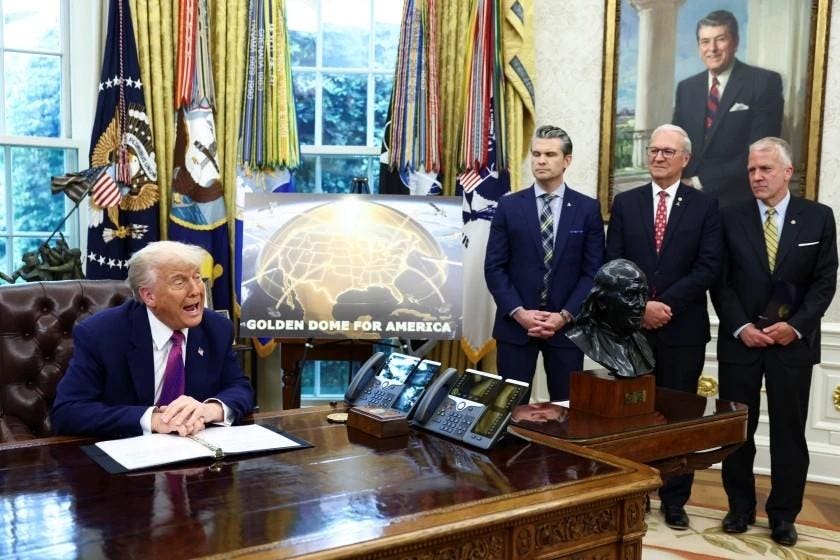
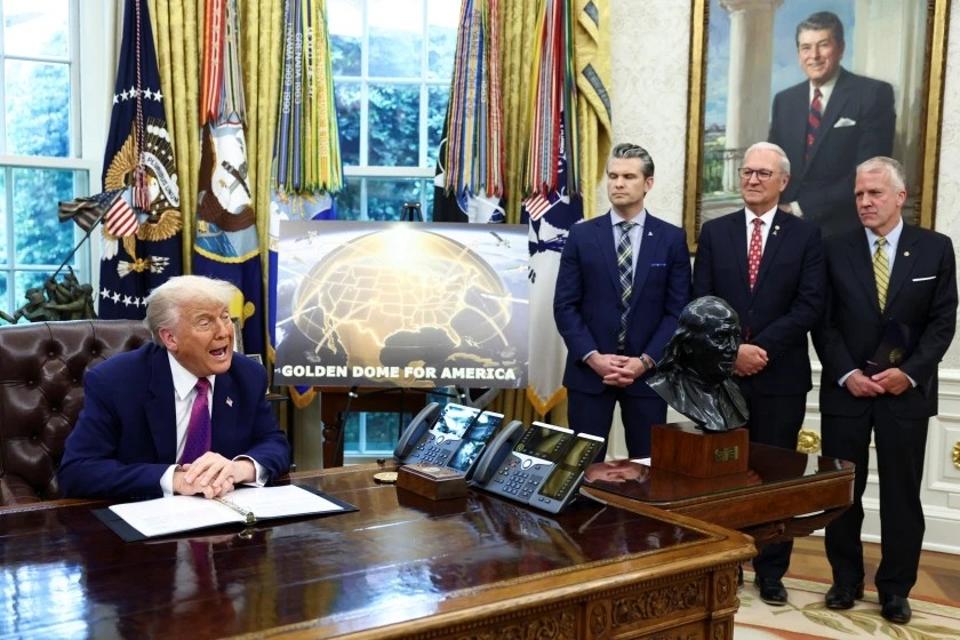
President Donald Trump announces the Golden Dome missile defense shield alongside Defense Secretary Pete Hegseth, Sen. Kevin Cramer, and Sen. Dan Sullivan in the Oval Office in May 2025.
Kevin Lamarque | Reuters
A revolution has been unfolding in military space—quiet yet unprecedented in both audacity and scale. Mass-produced, upgradeable small satellites are about to redefine U.S. space power — and today they’re just weeks from launching. At the direction of the Space Development Agency (SDA), the high-performance team created to answer President Trump’s “go fast” directive, the Space Force will launch the first 21 of an initial tranche of 126 communication satellites, followed by thousands more in the coming years.
These new satellites rely almost entirely on commercially available components, a completely different approach from the massive, bespoke TSAT geostationary platforms the Air Force pursued just 15 years ago. Each SDA satellite will receive software updates and new apps as routinely as your iPhone yet has actually more aggregate bandwidth and processing power than those TSATs that never made it into production. And the price is astronomically less — about 1 percent of those TSAT behemoths. Very soon, these new, low-cost yet highly capable satellites will be on orbit.
Once operational, these first satellites (and the 100+ soon to follow) will mark the operational debut of a radically more agile, affordable, and scalable approach to space warfare for America.
Until SDA, every new satellite program had followed a predictable pattern: larger and more expensive than their predecessors, and often late or cancelled. The Air Force, and later the Space Force, traditionally directed the specific design and deployment of highly customized, billion-dollar systems and launched them one at a time on rockets, which themselves cost hundreds of millions.
Everything began to shift six years ago with the creation of the Space Development Agency. Not just the renaming of an old Air Force command, it was the creation of a completely new agency to answer a pivotal question: could the military acquire small, commercial-grade satellites in volume, to meet real operational demands more affordably?
Fueled by a sustained confidence by Congress, the results have been nothing short of remarkable. With nine performing prime contractors on SDA’s missions today and more onboarding every year, satellite costs have plummeted from as much as $1+ billion (TSAT) to an average of $14 million each. The first set of SDA’s satellites, designated “Tranche 0,” achieved those radical cost, schedule, and technical goals. Those first ones have been on orbit for over three years now and have demonstrated enough promise that Congress is now asking for more of them. Over these three years, the Space Force has been gaining new and valuable operational experience in low earth orbit (LEO). With the imminent launch of T1, the Space Force will be orchestrating the operation of hundreds of meshed LEO satellites, each one circling Earth every 90 minutes at 17,000 miles per hour. This is vastly more complex than communicating with a single satellite parked over the same point on Earth for its 15-year life. This dynamic new orbital regime will offer unprecedented resiliency against a Chinese threat through the networked use of thousands of low cost satellites. As China continues to rapidly expand its own space presence, this Space Force launch demonstrates that we are outpacing them with the speed, scale, and precision to maintain superiority.
But America cannot declare victory just yet, minor setbacks are always a possibility. Launching satellites has become a fairly routine activity today, but unanticipated anomalies do still occur. Also, though component redundancy is a key part of the satellite design for additional resilience, some still may experience “infant anomalies” just as their commercial cousins like OneWeb and Starlink routinely do. When fully commissioned and operational however, the Space Force will be justified in taking a victory lap and deserve the accolades they will receive for such an historic achievement.
This launch will be the real test. Deploying the first 21 satellites simultaneously marks a sharp acceleration from experimentation to true operational reality. All 126 interoperable communication satellites were designed and built in less than three years by three different prime contractors. Each was assembled almost entirely with commercial parts and were delivered at scale and at fixed prices, all to government specs and standards.
Testing indicates they exceed the bandwidth and processing power of the billion-dollar systems the Pentagon once envisioned but never fielded. It’s like swapping today’s high performance fighter jets for mass-produced swarms of drones that are faster, cheaper, and routinely upgradeable with in-flight software enhancements. This kind of transformation has never occurred in government satellite programs; historically, performance improvements were delivered with soaring costs.
Soon, what was only dreamed of by Pentagon leaders 15 years ago will be their reality. Each of these satellites is American-made, Space Force-owned, and fully under military control. With intuitive software tools at their fingertips, today’s guardians will be able to operate, reprogram, and upgrade them as they see fit, with the ability to maneuver in real-time – a capability that space warfighters desperately need to dominate the contested space environment.
It’s unprecedented, not just in terms of cost and speed, but in scale, coordination, and combat-readiness. Never has the Pentagon fielded so much capability, so quickly and so affordably. Senator Kevin Cramer (R-ND), chairman of the Space Force Caucus and early and vocal proponent of SDA and President Trump’s Golden Dome For America, put it more bluntly: the Transport layer is what will “expand our space warfighting capability and foster growth in the U.S. space industrial base.”
The future of military space isn’t coming in some distant decade. It will be here soon, hurtling above us at 17,000 miles per hour.