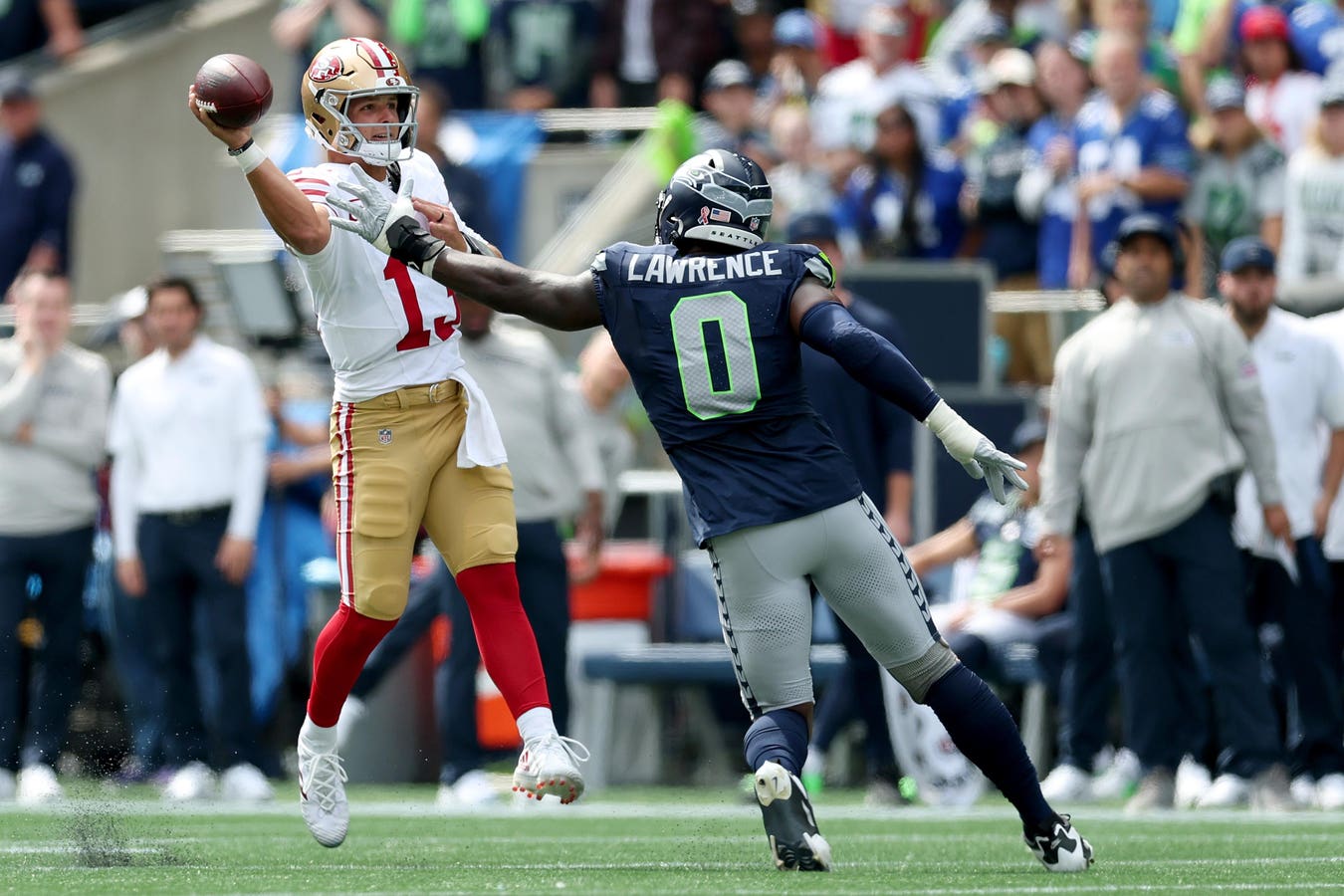
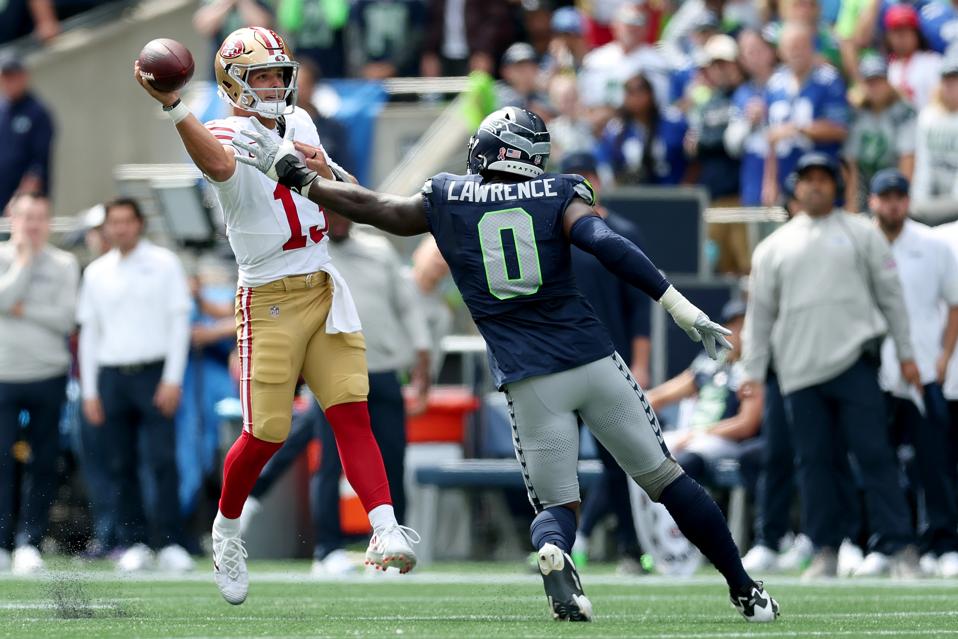
Brock Purdy #13 of the San Francisco 49ers, seen here pressured by DeMarcus Lawrence #0 of the Seattle Seahawks, injured his toe and left shoulder on Sunday. (Photo by Steph Chambers/Getty Images)
Getty Images
The San Francisco 49ers quarterback situation for their upcoming Week 2 game against the New Orleans Saints may not be Purdy. 49ers starting quarterback Brock Purdy suffered a left shoulder and toe injuries during the team’s 17-13 Week 1 win over the Seattle Seahawks. The 49ers have not specified what exactly happened to these body parts. But on Monday, their head coach Kyle Shanahan did indicate the following: “I’d probably say the toe’s worse than the shoulder… We’ve got to see how it heals and how the week goes.” And two days later, on Wednesday, Shanahan called Purdy’s chances of playing at New Orleans “a long shot.”
Purdy’s Status Depends On What Toe And What Part Of His Toe Is Injured
That’s all still Purdy non-specific. The severity, healing and availability of Purdy’s toe will depend heavily on which toe is injured and what specific part of the toe got injured. Back in March, I described in Forbes different ways different parts of your feet can get injured. That’s because TikToker were dropping heavy objects on their for the likes. Well, your toes are part of your feet and have the same five major components that comprise your feet: namely bones, ligaments connecting the bones across the toe joints, cartilage in the toe joints, soft tissue and nails. None of these are indestructible. Each can get damaged in different ways.
Toe Bones Can Get Fractured
Take the bones in your toes for instance. Your toe bones are known as phalanges. Foru of your toes have three phalanges each: the proximal, middle and distal ones. The big exception is your big toe, also known as the hallux or the big piggy. This one has only two phalanges: a proximal and a distal one.
Such bones can get fractured in various ways. On one end of the spectrum are stress fracture, which are very small, often described as hairline fractures that result from repetitive force and pounding to the bone over time. At the other end of the spectrum are breaks that happen when a single application of force is applied to the bone. This force can come something heavy falling on or pressing down on your toe like an anvil, refrigerator or defensive lineman or you toe getting twisted in an awkward manner.
When such breaks result in a piece of the bone slipping out of place, the fracture is considered displaced. A displaced fracture often requires surgical correction because otherwise the bone won’t heal in the proper position. Surgery is also typically necessary when the fracture is open, meaning that the bone has penetrated the skin in some manner versus a closed fracture where it hasn’t.
When the fracture is non-displaced, the big treatment tends to be time and rest to allow it to heal. A simple toe fracture usually takes four to six weeks to heal. This goes up to six to eight weeks when the fracture is more complex. Big toe fractures can take even longer since your big piggy has to support more weight.
Toe Bones Can Get Dislocated
A toe bone can get dislocated as well. This is when a bone gets knocked out of its joint either partially or completely. When your joint goes a-rocking in such a manner, you want to reduce the dislocation—meaning put the bone back in place— as soon as possible to avoid further damage. A closed reduction is when you manipulate the toe to put the bone back in its joint without cutting through the skin in any way. An open reduction is when you have to do it surgically. Naturally, when it comes to such reductions, you want someone who knows what he or she is doing. If someone takes out a broth, shallots and butter, tell the person it’s the wrong kind of reduction
When a toe dislocation is reduced rapidly and smoothly, you could resume regular activities within a day or two. However, a more severe dislocation or one in the big toe may keep you out of commission for a longer time— up to eight weeks. Even when a dislocation is reduced, the joint can remain unstable. It’s a good idea to be followed by a doctor.
Toe Ligaments Can Get Torn
That Natalie Imbruglia song goes, “Nothing’s fine, I’m torn.” Well, this can apply when you tear your toe ligaments, the bands of connective tissue that help connect the tow bones to each other and the rest of your foot and help hold the toe joints in place. A toe sprain is when you overstretch or tear such a ligament. One classic football injury is named turf toe, which is a sprain of the ligaments connecting the base of your big toe joint. The severity of a sprain depends on how much of the affected ligament is torn. A toe sprain that’s a partial tear usually takes three to six weeks to heal. A complete tear of a ligament may require surgery to re-attach the ligament.
The Soft Tissue And Nails Of Toes Can Get Damaged
Then there are the parts of the toes that you can more readily see: the soft tissue and nails. These can get damaged in different ways. You can bruises and bleeding. Friction and pressure on the soft tissue can lead to thickening, which is what you see with corns and calluses. The nails can get torn and damaged in various ways too.
Purdy Was Held Out Of Wednesday’s Practice
So while Purdy may not yet be toe-tally a scratch for this Sunday’s game, he did stay out of the 49ers practice on Wednesday. If Purdy can’t go this Sunday, Mac Jones, who played for the Jacksonville Jaguars last season, will start in his place.